Name what's real. Build a plan that fits it.
Effort is rarely what's missing. Plans fail when they ignore what the business actually lives with: its time, its capital, the market, the founder's bandwidth. We start there and design within it, so the plan fits and holds.
The whole structure, from culture to the operating plan.
Who are you as a company, and what do you stand for?
The shared values and purpose the company is built on. The leader shapes it; the whole team owns it.
Where do you actually stand?
Real strengths, real limits, and what's coming.
Do you know where the money is made?
How the business earns, who owns the numbers, and the work behind them.
Where do you compete, and how do you win?
Focus, customer, and the few bets that matter.
What do you commit to this year, and do in the next ninety days?
This year's commitments, and the ninety-day priorities that deliver them.
All five sets live on one page, the Growth Canvas.
“Greatness is not a function of circumstance. Greatness, it turns out, is largely a matter of conscious choice, and discipline.”
Jim Collins, Good to Great, ch. 1The Operating Plan is the fifth declaration set, and it comes last on purpose. Concentrate only there and you run a plan cut off from the identity, honest reality, numbers, and strategy that move value the most.
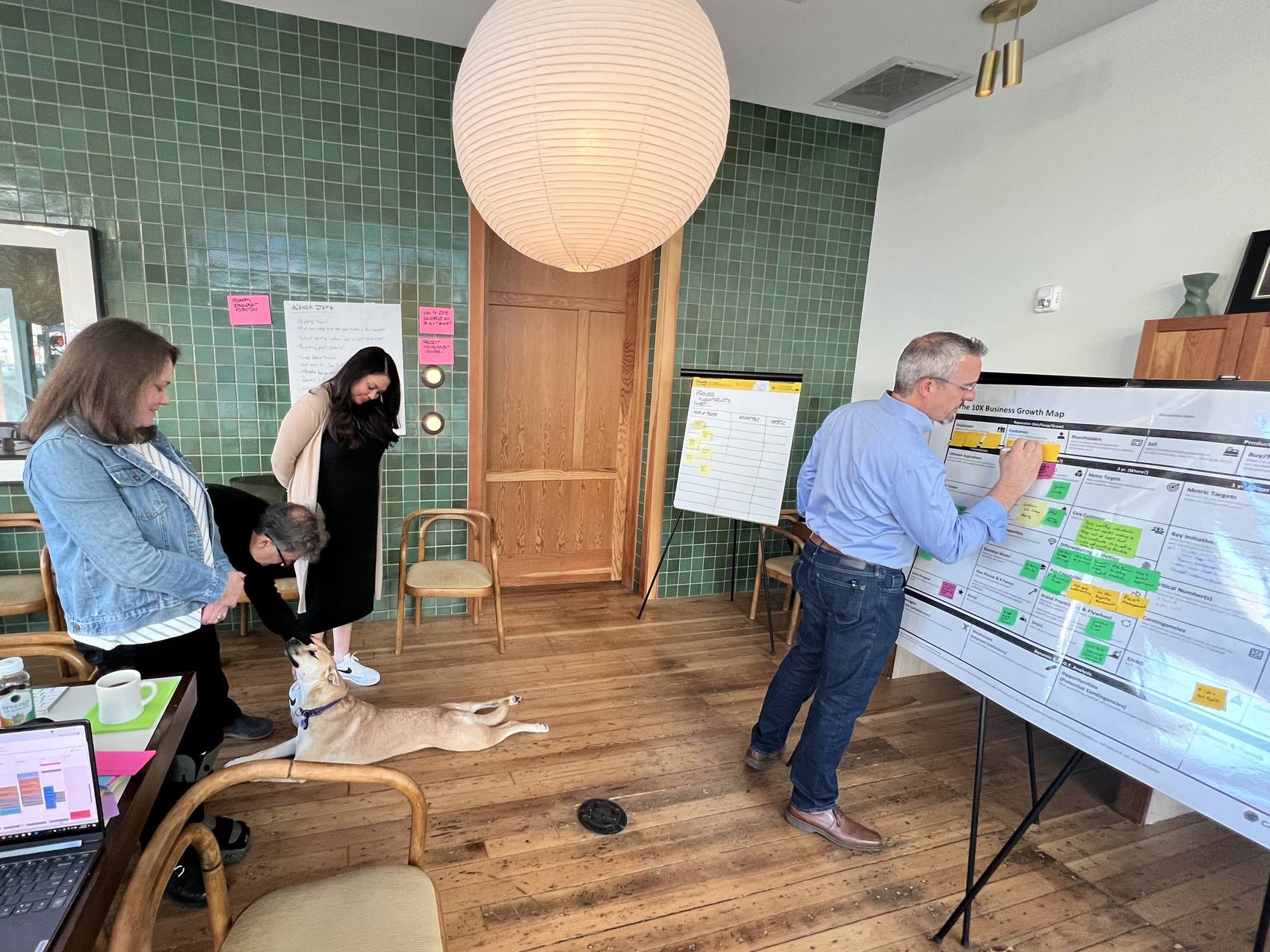
What it looks like on paper.
The structure is not a framework the team reads. It gets built in the room, on something big enough to argue over, and it stays up where everyone can see what was decided.
The owner's side first. Then the team's.
ValueX belongs to whoever holds the clock: the owner, or the firm behind the company. It ends with what crosses to the team. Design12 and Build90 belong to the leadership team, and they start from what was brought to them.
ValueX
For an owner, that is the business, your wealth and what you want next. For a firm, it is the thesis and the value creation plan, in whatever form they exist.
Design12
The founder or CEO opens the first workshop with the starting point the team inherits. The leadership team builds three years of direction from it.
when
needed
Build90
When the situation calls for it, Build90 extends the work in ninety-day cycles across three phases of value creation.
Every other option here has to sell you their system.
Investor-grade finance, inside the cadence
Your leaders learn to read and move the economics a buyer underwrites. "Profitable but broke" stops being a mystery, and the numbers hold up in diligence.
Strategy, built in
Where you compete and how you win is decided here, instead of assumed. Most systems track the plan.
Owned by your team
Value that depends on an outside operator in the weeds does not transfer, and a buyer knows it. So the capability is built into your team, and we measure it by a team that needs us less each year.
Governed by value, honestly
We do not chase the multiple; the market sets that. We build what earns it, and the proof is a business that runs without you.
Where each option takes you.
| EOS / Traction | Scaling Up | Exit planners | PE operating partners | Cadence Growth | |
|---|---|---|---|---|---|
| Primary focus | Operating system and accountability | Growth framework and meeting rhythm | The sale, and the assets to manage after it | Hands-on help inside a specialty | Enterprise value, built through finance and strategy |
| Who runs it | You, or a certified implementer | You, or a certified coach | The advisor, up to the deal | An operator placed inside the business | You take part; a senior partner facilitates, with your team |
| Time horizon | Until the team graduates, about two years | Ongoing rhythm | To the transaction | The hold period | A multi-year build, as long as it compounds |
| How far it takes you | A shared language and a meeting rhythm. | A rhythm to run yourself | To the closing table | As far as the specialty reaches | Foundation, then momentum and advantage |
Most companies arrive one of two ways. Some already run an operating system and need what it does not contain. Some run none, and the rhythm gets installed as part of the work, built to the same standard as everything else. Neither one needs a second system first.
Start a conversation.
We'll take a straight read on where your business stands and what's in the way.
Start a conversation